The 1972 Bombing of a Small-Town Cop
On February 24, 1972, a bomb detonated beneath Springdale Police Lt. Karl Martens’ vehicle. He survived. More than fifty years later, questions remain about who planted it, and why no one was ever convicted.

Springdale, Arkansas, 1972. The air smelled like asphalt, chicken feed, and sin. You could tell what shift the processing plants were on by the direction of the wind. Honeysuckle tried to fight it in spring, but it never won. This was a town teetering between progress and combustion.
Then, one February night, the air got a little bomby.
Lieutenant Karl Martens of the Springdale Police Department wasn’t just a cop. He was the kind of man who knew every engine by sound. He’d kept order through chicken strikes, factory fights, and all the usual chaos that only made headlines when blood spilled. On February 24, 1972, someone decided he shouldn’t see another sunrise.
The blast shattered the quiet, scattering shrapnel and suspicion across Northwest Arkansas. In a place like Springdale, rumors didn’t walk. They raced. Some blamed the Tyson strike, others said it was personal. A few swore it was something darker, that someone had brought dynamite to town and didn’t plan to leave alive.
The Investigation That Went Nowhere Fast
The Springdale Police Department and ATF tried to build a clean case. What they made was a maze. The investigative files I obtained through public-records requests show chaos in motion. Too many agencies, too many egos, too many notes written by men who didn’t trust each other.
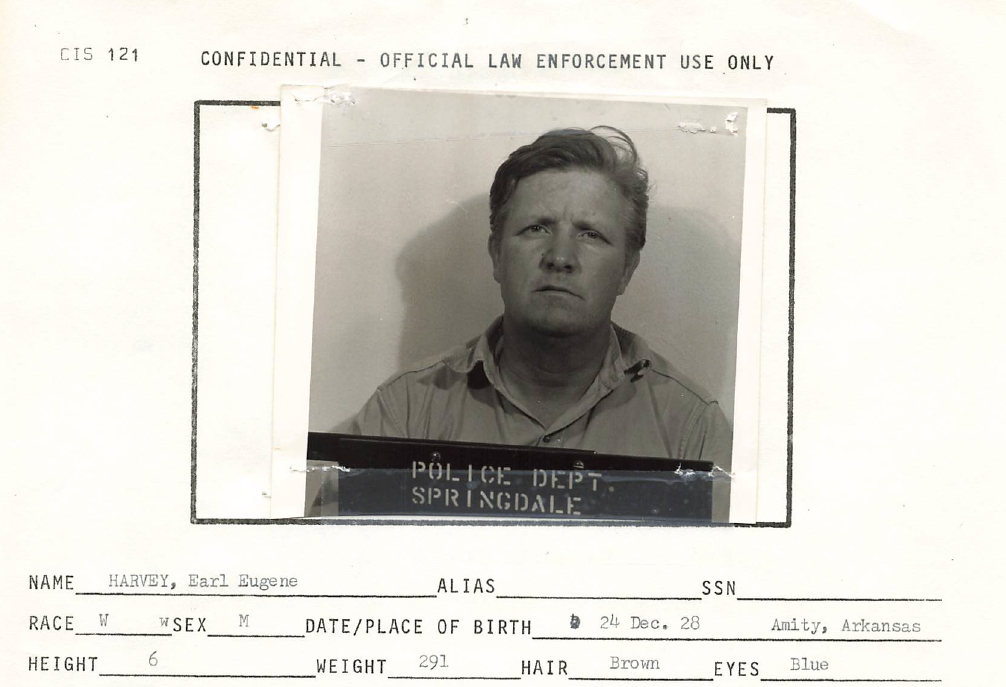
Earl Eugene Harvey — Springdale Police Department record
They pulled in Phillip Francis Esslinger, a 28-year-old farmer out of Missouri. He was caught in Rogers driving a 1959 Chevy with two sticks of Dupont gelatin dynamite and caps in the glove box. The man had the wrong answers to every question. The reports paint him as someone who knew enough about explosives to make people nervous, and too little about his own story to be believed.
Then came Dennis Eugene Cordes, the name that kept resurfacing. Police and investigative records describe a Springdale native with an extensive criminal history whose name appeared in drug investigations, assault cases, and enough police reports to wallpaper a cell.
Cordes had history with Martens and the department, and investigators had reasons to keep looking at him. The files describe motive, anger, and connections to people familiar with explosives.

Huntsville, Arkansas · Thursday, July 18, 1996
The Mother Who Wouldn’t Let Go
Years later, Cordes wound up behind bars again, this time on federal drug charges. Most men in his position would have stayed there. But his mother, Helen Wilkins, wasn’t most people.
In 1996, she and private investigator Connie Lewis helped him escape the Washington County Jail. They used smuggled tools, cut bolts, and drove him out through the night. When she was caught Helen Wilkins maintained that her son had been framed in connection with the Martens bombing.
It was hard to argue with her resolve. Helen wasn’t just defending a son. She was fighting the same system that had failed to solve Martens’ attempted murder.
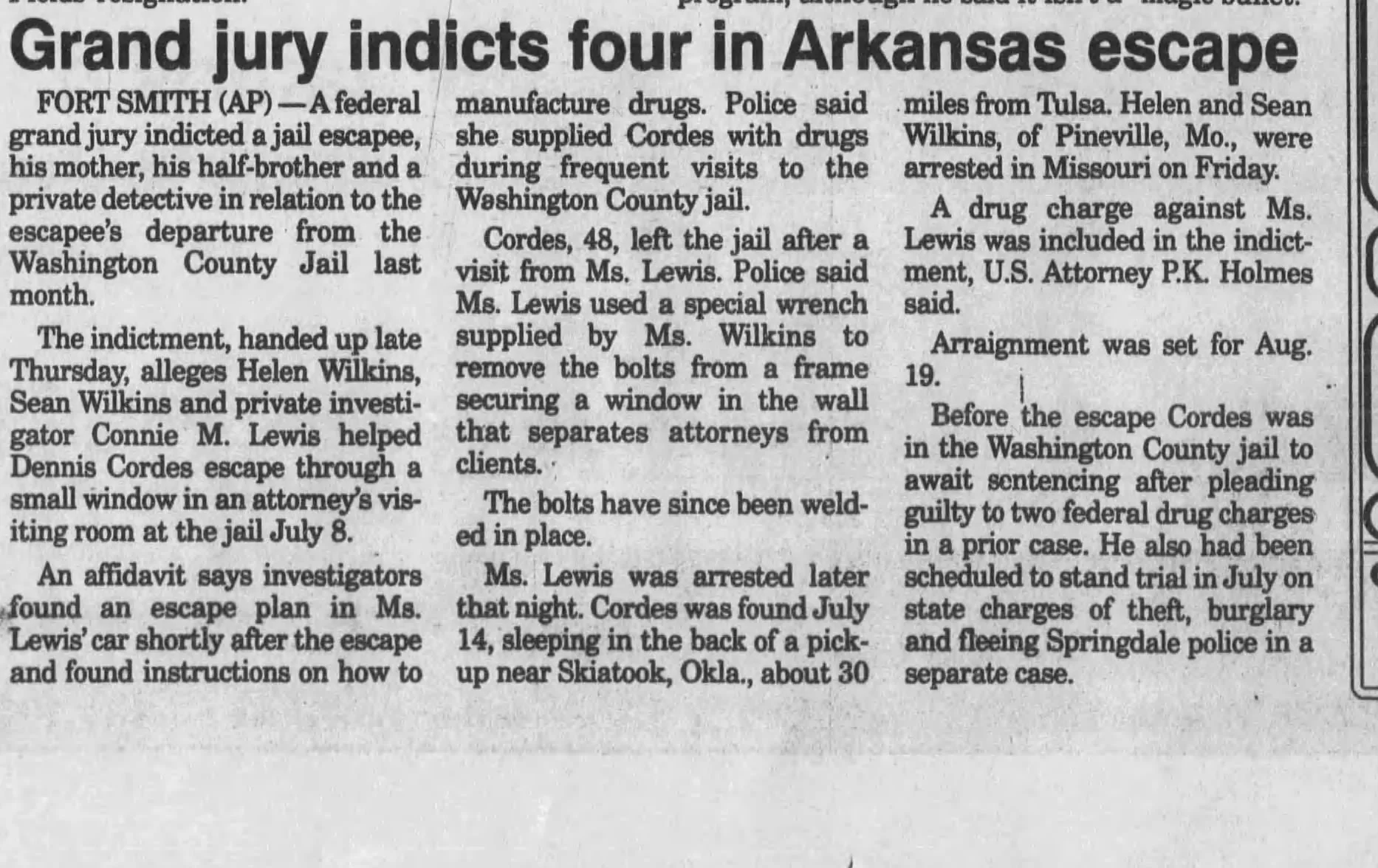
Fort Smith, Arkansas · Saturday, August 10, 1996
A Town That Wanted to Forget
Springdale today has paved over its scars, but the bones are still there. The Trade Winds Motel, the Holiday Inn, the feed mills, the neon signs humming through dust. Every piece of ground from that investigation is still standing.
The FOIA files—hundreds of pages of interviews, reports, redactions, receipts, and investigative notes—show a case that began with urgency and slowly lost momentum. Evidence was gathered, witnesses were questioned, and leads went stale. The ATF documented explosives, statements, suspects, and dead ends. Then the case simply stopped breathing.
More than fifty years later, the case remains a messy piece of Springdale history with no clean ending.
The Hard Truth
When I spoke with a Springdale Police contact who told me he had practically run the department through the late eighties and nineties, he didn’t dodge the question.
“They wanted it buried,” he told me. “And they buried it deep.”
The police contact believed Cordes was involved. Maybe not the man who lit the fuse, but close enough to smell the smoke. He said he had seen the files, talked to the men who worked the case, and knew exactly how far some people would go to protect their own.
Half a century later, the case still doesn’t make sense. The facts don’t align. The players are dead. The silence remains.
The Story That Wouldn’t Die
The 1972 bombing of Lt. Karl Martens wasn’t just a crime. It was the moment Springdale lost its sense of safety. After that night, people locked their doors. Cops stopped feeling untouchable.
Cordes went on to spend decades behind bars. He escaped once, got caught again, and died somewhere between regret and delusion. The man who thought he could outsmart everyone never outsmarted time.
Maybe he did it. Maybe he just knew who did. Maybe the truth was boxed up and filed under “unsolved” because it was easier that way.
Either way, the sound of that explosion still echoes through this town. And until the whole story is told, it always will.
Hear the Full Story: The 1972 Springdale Police Bombing
The companion episode of Things I Want to Know goes deeper into the bombing of Lt. Karl Martens, the suspects, the investigative files, and the questions that remain more than fifty years later.
Reporting Note:
This story is based on law-enforcement records obtained through public-records requests, contemporary newspaper coverage, and recorded interviews with people directly familiar with the investigation.