The Day Philadelphia Dropped a Bomb on Itself
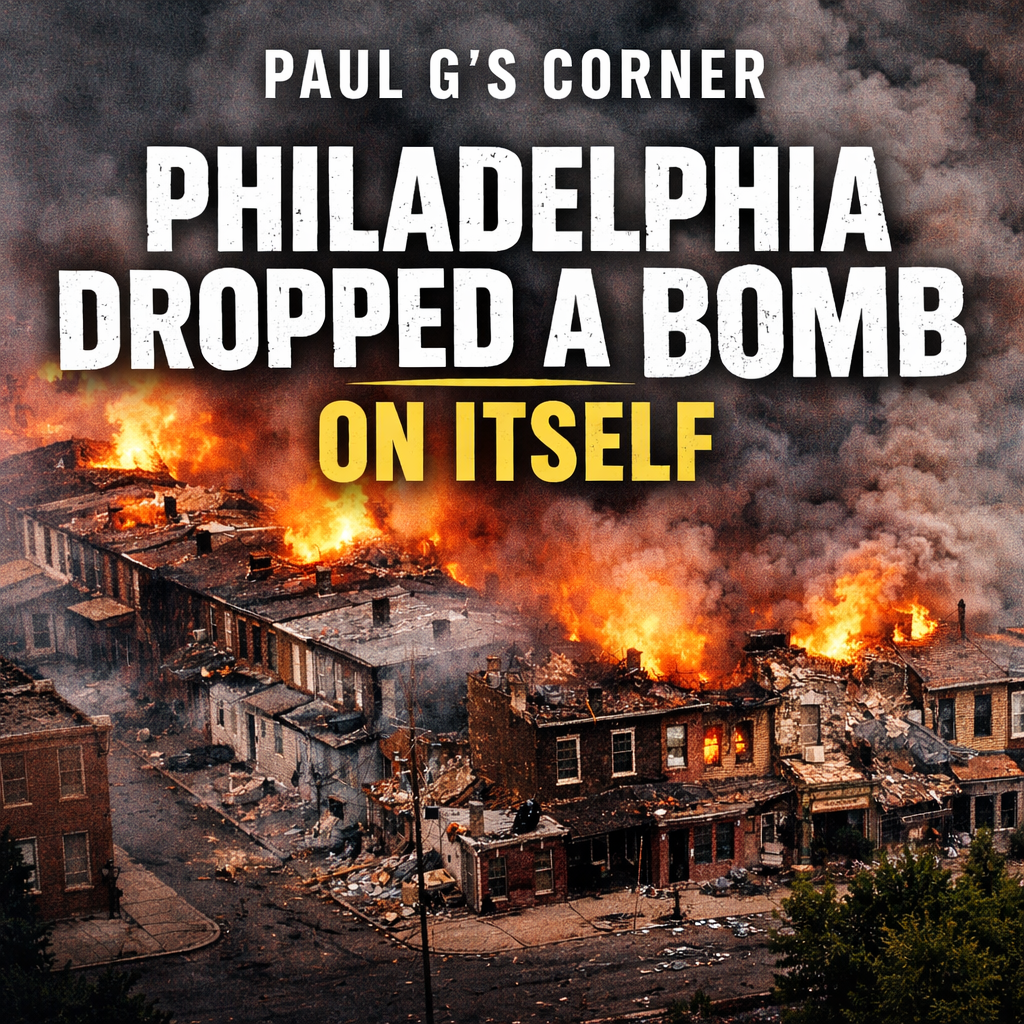
Philadelphia Dropped a Bomb on Its Own Neighborhood. Then It Let It Burn.
Sometimes you stumble onto a story and immediately wonder how in the hell you missed it. That is what happened here. On May 13, 1985, the City of Philadelphia dropped a bomb from a helicopter onto a rowhouse in a residential neighborhood. That sentence is not dressed up for effect. It is literal. A bomb. A helicopter. A house containing adults and children. Then came the fire.
Eleven people died, including five children. Sixty-one homes were destroyed and roughly 250 people were left homeless. Until fairly recently, I could not have told you much about it.
Before the Bomb
The story did not begin with a helicopter over Osage Avenue. MOVE was a radical organization founded in Philadelphia in the early 1970s around the teachings of John Africa. The group rejected much of modern society and developed an increasingly hostile relationship with Philadelphia authorities. That relationship had already turned deadly once. In 1978, a confrontation between MOVE and police ended in a gun battle that killed Philadelphia police officer James Ramp. Nine MOVE members were eventually imprisoned.
By the early 1980s, MOVE members had settled into a rowhouse at 6221 Osage Avenue in West Philadelphia. They demanded the release of imprisoned MOVE members and increasingly came into conflict with the people living around them. Neighbors complained about amplified messages, confrontations, sanitation problems, threats, and eventually a fortified bunker constructed on top of the house. That part matters because it is easy to tell this story backward and pretend Philadelphia woke up one morning and randomly decided to bomb somebody. It did not. There was a real conflict. Residents had legitimate complaints. Police had warrants. MOVE was not quietly sitting inside an ordinary house minding its own business. None of that explains what happened next.
The Morning of May 13
Police evacuated residents from the surrounding area and moved hundreds of officers into position. At approximately 6 a.m., Police Commissioner Gregore Sambor ordered the people inside the MOVE house to surrender. They did not. A gun battle followed. Police fired more than 10,000 rounds toward the house during roughly 90 minutes of the confrontation. Tear gas and high-pressure water were also used.
Eventually, authorities were confronted with another problem. MOVE had constructed a fortified bunker on the roof, and police wanted it gone. Someone came up with a solution. A bomb.
The Bomb
Mayor Wilson Goode authorized the use of an explosive device against the rooftop bunker. A Philadelphia police bomb unit dropped a satchel containing Tovex and C-4 explosives from a Pennsylvania State Police helicopter. The bomb landed on the roof, exploded, and started a fire.
This is where the story crosses from a disastrous police operation into something much harder to comprehend. Firefighters were already nearby, but they did not immediately put the fire out. Police Commissioner Sambor and Fire Commissioner William Richmond had agreed to allow it to burn temporarily because they believed the fire could destroy the bunker and force MOVE members from the house. In other words, the fire became part of the tactical plan.
Let It Burn
The fire spread, and by the time firefighters were ordered to seriously attack it, the fire was no longer interested in anybody's plan. Rowhouses are connected. One burning building becomes another burning building, and then another. The fire tore through Osage Avenue and Pine Street, destroying sixty-one houses and leaving roughly 250 people homeless.
Inside the MOVE house, six adults and five children died. Only two people inside survived, Ramona Africa and a child later known as Birdie Africa. The bomb itself is so extraordinary that it consumes all the oxygen in the room, but the bomb was only one decision. Allowing the fire to burn was another.
Nobody Started the Day Planning to Destroy a Neighborhood
This is where the story becomes more useful than simply saying, "Look at this horrible thing the government did." There had been years of conflict. Neighbors wanted something done. MOVE refused to leave. Police wanted to execute warrants. City officials did not want another humiliating confrontation. Police developed a tactical solution. That solution failed, so another solution was added, then another.
Every decision narrowed the number of remaining choices. The city needed MOVE out. Police needed the bunker removed. The bomb could remove the bunker. The fire could force people from the house. The fire needed to burn long enough to accomplish that. Suddenly an American city was watching one of its own neighborhoods burn on live television. That is how organizations sometimes create disasters, not because everyone sits around a table deciding to produce one, but because each decision makes the next bad decision seem slightly more reasonable.
The City Investigated Itself
Philadelphia could not simply move on. Mayor Goode appointed the Philadelphia Special Investigation Commission, commonly called the MOVE Commission, to investigate what happened. The commission interviewed hundreds of people, reviewed evidence, held televised hearings, and issued a report in 1986.
Its conclusion was not subtle. The commission described the bombing plan as reckless, ill-conceived, and hastily approved. It concluded that dropping a bomb on an occupied rowhouse should never have happened and criticized leadership and decision-making throughout the operation. A grand jury later declined to bring criminal charges against city officials. Despite the deaths, the destruction of an entire neighborhood, the commission findings, and years of litigation, nobody running the operation went to prison for what happened.
The People Who Lived Next Door
There is another part of this story that tends to disappear. The neighbors. People on Osage Avenue had spent years asking the city to deal with the problems surrounding MOVE. Then the city finally dealt with it by destroying their homes.
Imagine complaining to the government about the house next door and eventually having the government solve the problem by burning down yours. Those residents were not tactical abstractions. They had mortgages, photographs, furniture, clothes, children's bedrooms, and all the small pieces of a life nobody thinks about until they are gone. The bombing killed eleven people inside the MOVE house, but the consequences reached far beyond 6221 Osage Avenue.
Philadelphia Did Not Completely Forget
My first reaction to this story was that Philadelphia seemed to have simply buried it. That is not entirely fair. Pennsylvania eventually approved an official historical marker recognizing the MOVE bombing, and Philadelphia City Council formally apologized in 2020 while calling for May 13 to become an annual day of reflection and remembrance.
The city also spent decades dealing with lawsuits, rebuilding failures, community anger, and questions about accountability. Then, incredibly, another controversy emerged over the handling and disposition of remains belonging to MOVE victims. Philadelphia officials again found themselves apologizing for how people killed in the 1985 disaster had been treated after death. Apparently this story was not finished finding new ways to become disturbing.
The Part That Stays With Me
It is easy to turn the MOVE bombing into a political argument. Police versus radicals. Government versus citizens. Race. Authority. Extremism. Civil rights. Take whichever piece you like and you can probably build an argument around it.
That is not the part that interests me most. What interests me is the machinery of bad decisions. There was no single moment when sixty-one families agreed to sacrifice their houses. Nobody living down the block voted to become homeless. The five children inside the MOVE house certainly did not participate in the tactical planning. Yet a series of people with authority made decisions that, viewed one at a time, kept moving the operation toward something almost nobody would have accepted if you had described the ending at the beginning.
When Momentum Becomes the Decision Maker
Organizations are very good at following plans. They are not always as good at recognizing when the plan has become the problem. Once enough people, equipment, authority, and reputation are committed to a course of action, stopping can become psychologically harder than continuing. Backing down feels like failure. Changing plans feels like admitting the first plan was wrong. Someone says, "We have gone too far to stop now," and suddenly momentum is making decisions people should be making.
Philadelphia did not set out to burn sixty-one houses that morning. It still burned sixty-one houses. Eleven people still died. Five of them were still children. Intent matters. Results do too.
Listen to the Full Episode
On Paul G's Corner, I dig deeper into the MOVE bombing, the people involved, the decisions that led to the confrontation, and the moment "under control" turned into letting an American neighborhood burn.
When "under control" meant let it burn.
There are historical events that become famous because everyone remembers them. Then there are events like this, where the strange part is discovering how something this enormous could ever become unfamiliar.
Philadelphia dropped a bomb on Philadelphia. That happened.
The more interesting question is how many decisions had to become normal before somebody finally decided that dropping it made sense.