Vanished In the Driveway: Misty Dawn Faulkner
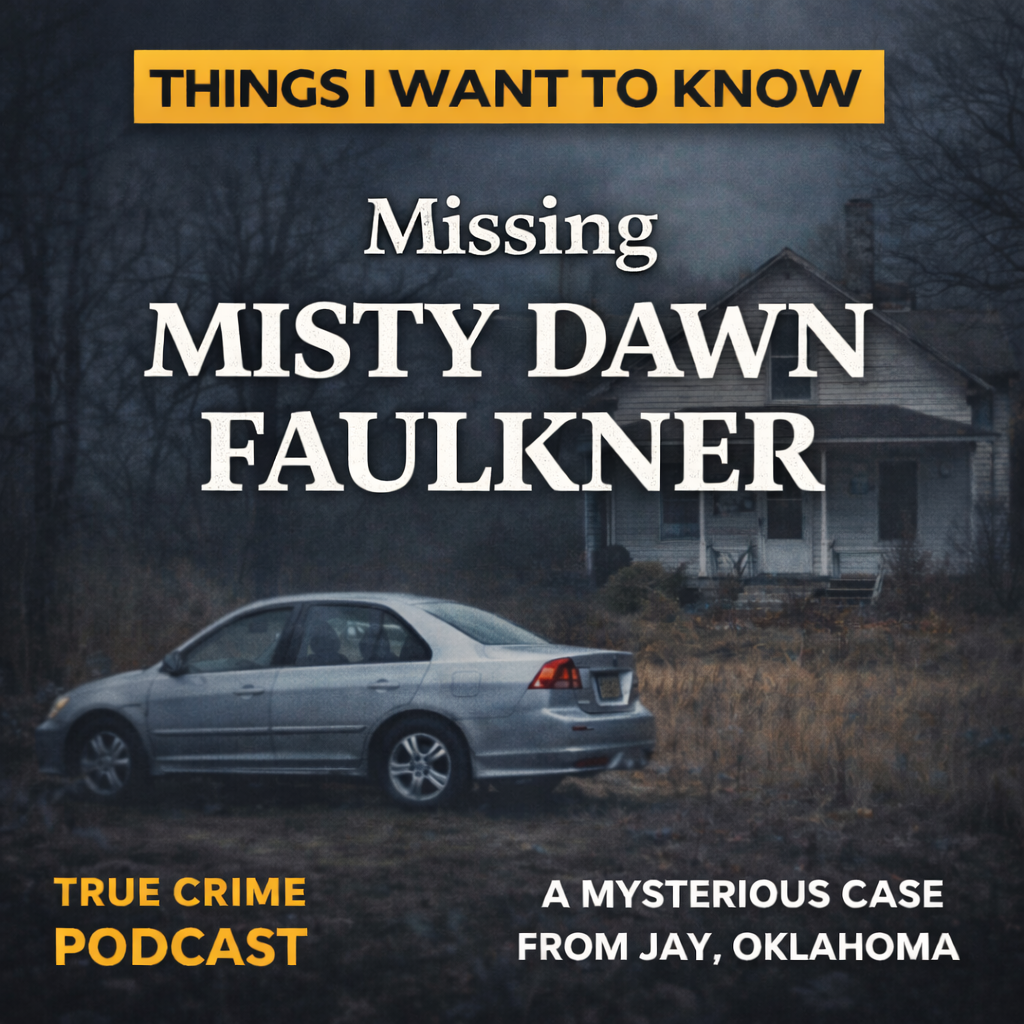
Misty Dawn Faulkner pulls into her grandparent’s driveway near Jay, Oklahoma, and then she is gone. That’s it. No cinematic struggle. No neighbor with the perfect memory. No clean little pivot you can hang your hat on.
The Disappearance of Misty Dawn Faulkner
A driveway is supposed to be where the day ends. You pull in, you’re home, and whatever was waiting for you out in the world stays on the other side of the door. Misty Dawn Faulkner pulled into one near Jay, Oklahoma, and then she was gone.
That is what makes this case so unsettling. There is no cinematic struggle, no witness with a perfect memory, and no single detail that explains what happened next. Her vehicle was locked. Her purse was left behind. Her phone was left behind. The groceries were still there. Everything looked ordinary except for the fact that Misty was missing.
When Ordinary Becomes Wrong
This is usually where our brains start writing a better story than the evidence gives us. It must have been an abduction. It must have been a stranger. There must be some sinister mastermind hiding just outside the frame. Anything feels easier than accepting that sometimes a person disappears and leaves behind no explanation that makes the world feel orderly again.
There is another problem with that reflex. A missing-person report does not automatically mean kidnapping. Most missing-person cases are eventually resolved. People leave for all kinds of reasons, including family conflict, addiction, mental-health crises, relationships, fear, anger, or simply wanting to disappear for a while.
Saying that does not minimize Misty’s disappearance. It does the opposite. It forces us to distinguish what we know from what we desperately want to explain. The public hears “missing” and often translates it immediately into “abducted.” Real investigations do not have that luxury.
Facts, Theories, and Everything Between Them
On this episode of Things I Want To Know, we stay with what can actually be supported and leave rumor where it belongs. We talk about polygraphs for what they are, an investigative tool, not a magical machine that stamps innocent or guilty on somebody’s forehead.
We also look at searches that involved enormous effort and still produced nothing, because sometimes that is exactly what an investigation looks like. Acres get searched. People get interviewed. Leads get chased. Questions get asked again and again, and the answer can still be silence.
That silence creates a vacuum, and people are remarkably good at filling a vacuum with whatever theory makes the most sense to them. The problem is that a believable theory is still only a theory.
The People Left Behind
The part that matters most is not the mystery. It is what the mystery did to the people left behind.
Two children grew up without their mother. A family has spent years living with a question that never closes. Everyone else is left staring at a locked vehicle, an abandoned purse, a phone, groceries that never made it inside, and one impossible question:
How does someone vanish from the place where she was supposed to be home?
That is a much harder question than the ones true-crime stories usually give us because there is no satisfying answer waiting at the end.
Why These Cases Stay With Us
That question is part of what keeps drawing me back to unresolved cases in this region. Sometimes there are no suspects. Sometimes there are suspects but no prosecution. Sometimes investigators accumulate years of information and still cannot cross the distance between suspicion and proof.
In the Christopher Alvard murder case, three men were arrested in connection with the killing of Alvard and his dog near Eureka Springs, Arkansas. A key witness later recanted, the prosecution unraveled, and no one was convicted.
Then there is the 1972 bombing of Springdale Police Lt. Karl Martens. Martens survived a bomb planted beneath his vehicle. Investigators developed suspects and accumulated years of records, yet more than half a century later the case still has no courtroom ending.
The circumstances are completely different, but all three stories eventually arrive at the same uncomfortable place. There is a point where the available evidence ends and uncertainty begins.
Where Evidence Ends
That is where people have to be careful.
Facts are facts. Theories are theories. Asking questions is useful. Inventing answers is not.
The internet makes it incredibly easy to transform uncertainty into certainty simply by repeating something enough times. A rumor becomes a theory. A theory becomes an accusation. Before long, people forget where the information originally came from.
That is particularly dangerous when the people involved are real.
Misty Is Still Missing
If you know something about Misty Dawn Faulkner’s disappearance, take that information to law enforcement. If you do not, resist the urge to manufacture an explanation simply because uncertainty is uncomfortable.
Misty Faulkner was a real woman. Two children lost their mother. A family has lived for years without an answer.
Her disappearance is not a campfire story.
Somebody knows what happened.