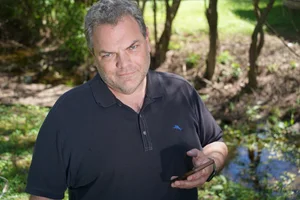
Ed Danko on Media Bias, Politics and the Collapse of Public Trust

Ed Danko
What Happens When a News Producer Stops Trusting the News?
Ed Danko spent years working inside television news before walking away convinced that the system had become politically distorted. Then he went into politics himself, which makes his criticism of the media considerably more interesting than the usual complaints coming from someone yelling at a television.
From the Newsroom to City Hall
When I interviewed Ed Danko, I expected politics. What I got was politics, television news, polling, Donald Trump, local government, media distrust, Palm Coast, and enough blunt opinions to make it fairly obvious that Danko has never spent much time worrying about whether everyone in the room agrees with him.
At the time of our conversation, Danko was serving on the Palm Coast City Council representing District 1. His background was a strange mixture that made the discussion more interesting than the usual conversation with a local politician. He was a Navy veteran, had worked as a television network news producer and editor, and had eventually moved from covering public officials to becoming one himself. His Palm Coast council term ran from 2020 through 2024, giving him four years on the other side of the cameras and microphones he once worked around professionally.
From the Newsroom to Politics
The part of Danko's story that caught my attention was not simply that he became a conservative politician. Plenty of people do that. What interested me was that he had spent years working inside television news before developing some extremely strong opinions about the way television news operates.
During our interview, Danko described becoming increasingly dissatisfied with what he believed was political bias inside the industry, particularly during the 2016 presidential campaign. He told me that he eventually gave CNN notice and walked away, and he described his frustration with polling and the way political information was presented inside the media environment where he had worked.
One of his stronger statements was, "Making up your own mind doesn't happen nowadays, and that's unfortunate." He went considerably further when discussing polling, telling me that he believed the numbers he was seeing inside the industry were being shaped in ways that favored Democrats and underestimated Donald Trump's support.
That was Danko's claim and his interpretation of what he experienced. I cannot independently establish from our conversation that CNN or its polling operation intentionally manipulated polling samples for political purposes, and I would not present the accusation as an established fact simply because a former employee believed it happened. What I found more interesting was the level of distrust coming from someone who had actually worked inside the business.
There is a meaningful difference between somebody yelling "fake news" at a television and somebody who spent years helping produce television news deciding that he no longer trusted the process. That does not automatically make Danko correct, but it makes the question worth asking.
What Happens When Nobody Trusts the Referee?
The media portion of our conversation eventually became larger than CNN or Donald Trump because the underlying problem is not particularly partisan. Americans increasingly consume information from sources they already trust, and those sources are frequently the ones most likely to tell them that everyone on the other side is either dishonest, stupid, dangerous, or some combination of the three.
That produces a fairly obvious problem. If conservatives believe mainstream journalism is deliberately manipulating information while liberals believe conservative media exists primarily to manufacture outrage and misinformation, then the argument is no longer about what happened. The argument becomes whether there is any source capable of telling us what happened in the first place.
Danko's answer was essentially that people need to seek information broadly enough to make up their own minds. I agree with the basic principle, although I would add something that political discussions often leave out: consuming several sources does not help much if all you are doing is collecting several versions of information that already agree with you. Diverse information is useful precisely because some of it should irritate you.
The Difference Between National Politics and Local Government
Our conversation also moved into Palm Coast itself, and this is where Danko became less of a television-news critic and more obviously a local politician. He talked about fiscal conservatism, taxes, businesses, restaurants, beaches, community service, and the things he believed made Palm Coast worth protecting and improving.
Local government is strange because the rhetoric can sound national while the actual work is usually painfully specific. Presidents get to talk about China, immigration, wars, and trillion-dollar budgets. City council members eventually have to vote on drainage, roads, equipment, zoning, development, utility costs, and whether somebody's neighborhood is about to get something the neighbors absolutely do not want.
That distinction mattered during Danko's time on the council. He was outspoken, sometimes combative, and certainly willing to turn policy disagreements into political arguments. Supporters could see that as someone refusing to become another quiet government official. Critics could see exactly the same behavior and conclude that he made governing unnecessarily confrontational.
Both reactions are fairly predictable because assertiveness looks considerably different depending on whether the person being assertive agrees with you.
Politics Without Much Filter
Danko was never particularly interested in softening the edges of what he believed. Toward the end of our conversation, he told me, "I'm an American first person, and you sound like one too. And we gotta take this country back because if we lose this country, it's over."
That sentence probably tells you more about his political style than a page of campaign literature could.
Some people will hear urgency and patriotism in it. Others will hear the familiar language of political alarm that has become common across American politics. I heard a man who believed the political stakes were considerably higher than another election cycle and had little interest in pretending otherwise.
I do not believe an interview becomes more useful because I agree with everything the person says, and I certainly do not believe disagreement automatically makes somebody unworthy of being heard. The interesting part is usually figuring out how someone arrived at the position in the first place, especially when that person has moved through different worlds and has seen institutions from more than one side.
Danko had been in the military, worked in network television news, participated in community organizations, and then sat behind the desk as an elected city official. Whether somebody likes his conclusions or not, those experiences helped produce them.
What Happened After the Interview
Danko's Palm Coast council service eventually ended in 2024. Rather than seeking another council term, he ran for the Republican nomination for the Flagler County Commission District 5 seat. The race was extraordinarily close. Official results ultimately showed Pam Richardson defeating him 7,590 votes to 7,551, a difference of only 39 votes after a recount.
That result seems almost appropriate for somebody whose political career has involved strong opinions and close arguments. He did not quietly disappear from local politics after serving his council term, but neither did the next election produce the result he wanted.
Politics does that rather efficiently. You can have a microphone, supporters, endorsements, arguments, advertisements, and absolute confidence that the voters understand what is at stake, and eventually somebody counts the ballots.
Then the voters get the last word.
Why I Remember the Conversation
The original interview is no longer available, which is unfortunate because Danko was exactly the sort of guest who made a conversation move whether you agreed with him or not. He did not require much prompting, and he certainly did not arrive with the carefully disinfected language politicians often use when they are terrified that one sentence might someday appear in an advertisement against them.
What remains useful is the larger question underneath the conversation. What happens when somebody who once helped create television news becomes convinced that the institution cannot be trusted? What happens when distrust of national institutions becomes part of local politics? And how much of our political division comes from actual disagreement over policy compared with the increasingly common belief that the people providing us information are manipulating the game before the argument even begins?
I do not have a neat answer to that, and Ed Danko certainly had his own.
That was what made talking with him interesting in the first place.